
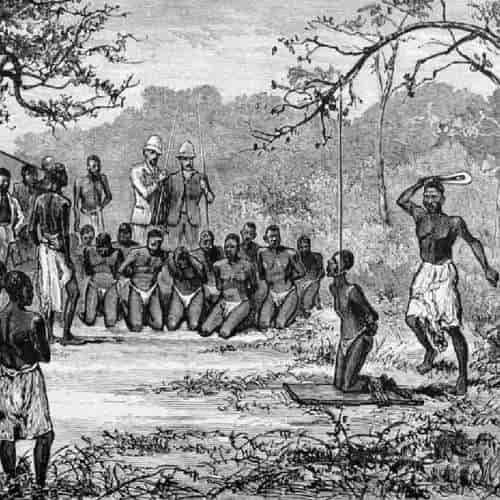
Names like Hitler’s often come to mind when we think of those responsible for the deaths of millions. There is another figure, far less known, who is widely held responsible for the deaths of around 15 million Africans: Leopold II, King of Belgium.
Leopold inflicted a catastrophe on an entire country, killing a large part of the Congolese people. So it is striking how few people know his story. He ruled between 1865 and 1909. When he came to power he was a seemingly respectable member of the royal family. Everything changed when he gained control of the Congo in 1885.
How did that happen? In the late 19th century, Africa was carved up and claimed by European powers such as France, Britain and Portugal in the age of colonialism.
Colonies were taken by European states that presented themselves to Africans as liberators who would manage their land and economy better—and thus, it was claimed, give the continent’s inhabitants a better life. In reality, that was never true, anywhere.
The British Empire led the scramble for Africa and claimed northern regions, South Africa and much of West Africa. The French held Algeria and Madagascar. The Italians held Somalia and Libya, the Portuguese Angola and Mozambique, and the Germans much of the rest. The only area at the very centre that had not yet been taken was the Congo basin.
Leopold knew the region was rich in resources such as rubber, gold and ivory. On a map, Belgium and the Congo show how vast the difference is: the Congo is more than 70 times the size of Belgium and was home to millions of Africans.
He could not simply invade with his small army—and given the jungle terrain, such an operation would have been costly and impractical.
Since the Congo was not yet held by any other European power, Leopold asked the other powers for permission to form the International African Association—ostensibly a philanthropic organisation to help Africans economically and convert them to Christianity.
In reality it was a front to persuade the Belgian government to fund his real aim: the full exploitation of the Congo by the Belgian king.
Once he had the money, what Leopold did was far from charitable. He forced Congolese people into forced labour under brutal conditions of hunger and exhaustion.
People were forced to search rivers and soil for gold, kill elephants for ivory and clear vast stretches of forest to create rubber plantations across the country.
Leopold brought mineral wealth, rubber and ivory into Europe through this system of slave labour and grew rich. He also sold Congolese people as slaves.
How did he organise this across the whole of the Congo? Leopold was shrewd and used his wealth and power in Belgium. First, he turned Congolese people against each other. In 1877 he formed a mercenary force called the “Force Publique” (Public Force), made up of Congolese soldiers and European officers paid to defend the Belgian king’s interests in the Congo. The most powerful within this force effectively became the government of the country.
That government was authoritarian and controlled all aspects of people’s labour. If people did not meet their monthly quotas, they were punished. The most common punishment was mutilation. If workers fled, the force mutilated their relatives. Slowly, reports spread of devastated villages and thousands of people with amputated limbs.
The administration was paid by commission, so Leopold gave the force a direct incentive to impose order. The result was that millions of people, including children, died at work. Leopold and his circle also went on unchecked safaris in the jungle, typically killing lions and elephants.
No one knows the exact population of the Congo before colonisation, but it is estimated at around 20 million. After Leopold’s rule, the population had fallen to below 10 million.
How did his rule end? Largely because of competition. The United States, Britain and the Netherlands gained territory with rubber and competed with Leopold in the market. Those three powers forced Leopold to hand the Congo over to the Belgian state, which also oppressed the people for many more years until the country’s independence in 1960.
To this day, the Congo faces economic and political instability—a country rich in minerals and natural beauty that is still shaken by internal conflict and regimes that show little interest in democratic processes.
For more on violence, power and human nature, read The Violence Within Us and Ethics and Empathy: Priceless Gifts for a Society of Peaceful Coexistence.
Happy Life Team