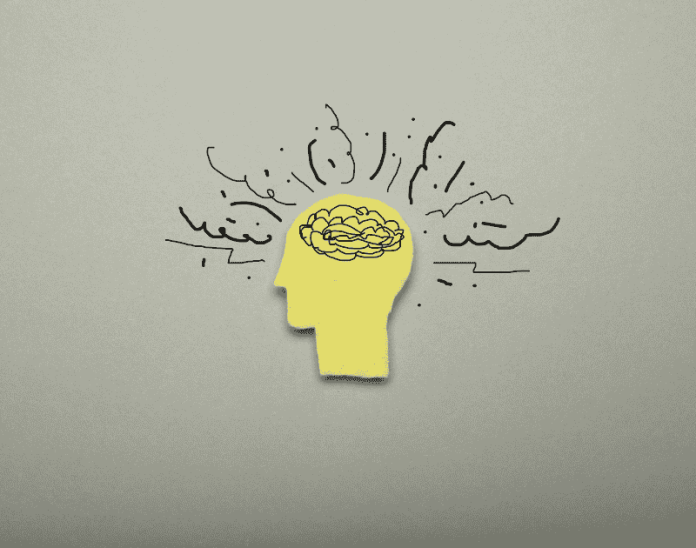
The brain constantly produces thoughts, feelings, sensations and perceptions, so there’s a lot competing for our attention. We focus on what matters for what we want to do, yet we spend about 46.9% of our waking hours thinking about something other than what we’re actually doing [1].
The mind naturally wanders from one thought to another, moving between memories, daydreams, goals and plans. This wandering is the brain’s healthy default mode and is linked to creativity and goal-directed thinking. The fact that our brain is “always on” has evolutionary benefits, helping us process and store the huge amount of information we take in every day so we can survive and adapt. The average person has around 6.5 thoughts per minute, or about 6,200 thoughts per day [2].
How the negative bias is triggered
Although most of our thoughts aren’t strongly positive or negative, when we meet negative stimuli the brain reacts with increased neural activity. As a result we tend to notice negative information more easily, treat negative data as more important, remember negative events more vividly and dwell on negative thoughts longer, while we overlook or downplay positive information such as joy or praise. This is because our brain is wired with a negativity bias that helps us stay alert to danger and spot threats as early as possible.
Unfortunately this also makes us more affected by bad news than by good or neutral news. We’re more likely to remember unpleasant events and slights. We also react more strongly to negative stimuli and may think about them more often.
It’s important to soften this negative bias so we don’t add a layer of self-criticism for having negative thoughts. Although the bias is normal, it can push us to focus more on the negative as we try to make sense of the world. Our tendency to dwell more often and more intensely on negative stimuli and to make decisions based on negative information can turn into a stuck pattern—a chain reaction of negative thoughts. The more negative the thoughts, the narrower the range becomes and the more likely it is to lead to unhealthy low mood, rumination and obsession [3].
The impact of negative thoughts
Getting stuck on negative information and dark thoughts can lead people to expect the worst of others and to focus only on negative exchanges, damaging relationships.
Rumination can also affect decision-making and make it harder to keep an optimistic view of life. Excessive, repeated negative thoughts get in the way of other kinds of thinking. Being caught in a negative thought loop can contribute to sleeplessness, anxiety, low self-esteem, catastrophic thinking, low mood and physical discomfort. [4]
How to work with our tendency toward negative thinking
Awareness is the first step. Try to step back from the negativity and look at your thoughts with neutrality. Notice possible triggers you could avoid, including negative people and settings. See how overgeneralizing, comparing and jumping to conclusions can fuel and prolong negativity. Pay attention to the words you use with yourself and try to bring more kindness into your self-talk.
Once you notice a negative pattern, you can start building new ones to redirect your attention or focus on more positive experiences.
Gratitude and creativity: two powerful tools
Practising gratitude is a powerful technique. It encourages you to look for the good and to believe that things can get better. Learning to set boundaries with negative people will reduce negative triggers—choose instead to spend time with people who support and lift you. Also learn how to relax on your own. That can be as simple as taking time to breathe deeply and letting thoughts come and go without judging them.
Redirecting your attention is another good strategy. Physical activity can help stop a spiral. A walk (especially in nature), exercise, or turning up the music and moving to the beat are all good ways to shift your mind away from what’s pulling it down.
Remember that negative thoughts and feelings are normal. The aim isn’t to wipe them out completely—as human beings we can’t. The aim is to recognize your own agency: your ability to turn something negative into something different.
Creativity is a great goal and an effective intervention. Channelling negative thoughts into writing, for example, can help you sort out and name what’s going on. Writing can also slow your thoughts down and bring clarity. Sometimes it can open the door to new solutions. There are many other creative outlets—singing, cooking, dancing, drawing—and negativity can be fertile ground for creativity. Don’t pressure yourself to create a masterpiece. Something as simple as a sketch can ease tension and redirect destructive thoughts and feelings. Repeating creative activities like these can support mood and wellbeing.
You don’t have to be driven by a negative mindset. The key is understanding what’s happening and recognizing that it’s your choice and within your power to intervene. By learning other strategies and practising creativity, you can replace worry and rumination with a more positive outlook.
For more on self-knowledge and facing the parts of ourselves we’d rather avoid, read our articles Thoughts on Self-Knowledge and Your Deepest Darkness Is Also the Source of Your Strength. For more on balance and living in the moment, see Happiness as an Absolute Goal.
Happy Life Team
[1] Killingsworth & Gilbert, 2010).
[2] Tseng & Poppenk, 2020).
[3] Haelle, 2021).
[4] W: Jerome/DALL.E